
Michelle's 2025 Letter
Notes from China factories, Silicon Valley AI startups, and policymakers as we enter a new global order

A few days late, which is on time for me. This letter was inspired after reading others’ 2025 essays, including Zhengdong and Dan Wang’s.
Last year highlighted a messy love triangle between China, Silicon Valley, and Washington. The DC-China pair seems to be heading for divorce. The Bay is deeply entangled with both sides for practical needs, such as rare earths and regulatory approval. All three would like to be single yet are undeniably co-dependent.
San Francisco is ironically mimetic. When Washington is singing its hawkish tune, small trips of five to ten founders and investors are quietly going back to China to assess their competition and take one last look. Xi has professed his internal reunification timeline for 2027—no one knows when the invasion will happen but let’s see what China is like before it’s too late. After hearing many robotics software pitches, I organized a robotics supply chain trip to Shenzhen, Shanghai, Hangzhou, Ningbo, and Suzhou to tour factories and ask questions to line workers. This was at first for my personal learning on how robots are even made (not a question one can answer from their San Francisco office), and I ended up bringing seven other founders—a mix of ex-SpaceX, Palantir, and Figure friends. Playing translator, I led Q&As with CEOs of factories producing core robotic components such as actuators. And I was reminded of growing up and spending summers in Shenzhen factories - its glaringly green floors, the buzzing of machines, sweaty line workers (now paired by cobots) dressed in orange and green uniforms, and warm, freshly precision-machined parts lined up in wooden crates.
We walked around production lines led by usually a forty-something-year-old factory boss (who looks more like fifty - it’s not an easy business!), inspecting quality and making sure employees weren’t watching Douyin. These factory CEOs are usually equipped with a high school diploma, a larger than usual risk appetite (thanks to Deng’s economic policy) and caught the wave of starting businesses during a period of economic growth. One founder on my trip, who wants to build precision robots for assembly, asked why this factory owner—who started off building motors for mahjong tables—was pivoting into robotics so cautiously. His logical response focused on entry barriers, factory equipment costs, labor changes (many young Chinese college graduates don’t want to work in factories), and automation. It sounded almost like a McKinsey MECE framework. These factory owners are serious people who know their line of work and can sense a shift in robotics; they want to bet the next ten or twenty years of their factory on this market. However, they can’t go all in like Silicon Valley startups because their margins are razor thin.
At Yale, I wanted to study technology, policy, and geopolitics—one avenue I discovered early on for this intersection was antitrust economics. From my Yale Law School to graduate economics coursework, I had one message pounded into me: promoting competition leads to better outcomes for consumers. When talking to Chinese factory owners who sighed at “involution,” I realized that the benefits of competition geopolitically had historically accrued to the Western buyer, whose design and brand gave them leverage. Tables are turning now. During the pandemic, the U.S. (maybe China knew and didn’t say) realized how much leverage we had given up through outsourcing the painful nuts and bolts, assuming free trade would work, and combined with our government’s historic lack of long-term industrial policy thinking.
The Biden administration made one of the first attempts at modern U.S. industrial policy on semiconductors, cleantech, and infrastructure. For the latter two, I cannot speak to in detail; however, for the CHIPS Act, my firsthand experience applying for this grant at my last startup, Cerebras, was quite prolonged. At the time, I was supporting Cerebras CEO, Andrew, on government partnerships with both the U.S. and sovereigns in the Middle East. Seeing how our COO was expanding manufacturing for advanced packaging, I noted how it could qualify us for a CHIPS grant. Unlike other fabless chip designers like Nvidia or Groq, our very large “wafer-scale” chip required many customizations, including our own packaging system. While I took Andrew to meet with senior investment directors and heads of the CHIPS office, the application—from first draft to negotiating a Letter of Intent—took over a year. In the last week before Biden’s team left office, the CHIPS office worked with a sense of urgency that had been obscured earlier in the year. I had other reasons to take red-eyes to Washington. Export control policy was top of mind for any AI chip company. Cerebras does a lot of business with the UAE and Biden’s team, unlike Trump’s today, attempted to tightly control chip flow, but unfortunately couldn’t stamp loopholes in cloud and resellers. For chips, China is behind today but it has the talent, power, and willpower to manufacture leading edge nodes. What effective export control policy looks like hinges not only on China’s timeline to catch up but also on our timeline for AGI. If it’s 2027, we shouldn’t be selling a single chip, but if it’s 2040, that’s a different policy.
Semiconductors are an interesting case study of capitalism and government incentives. Take Cerebras for example, its five founders are pedigreed veterans in the industry who had the sheer force of will to bring wafer-scale innovation to life. That’s what it took for Cerebras to exist. While many say Chinese industrial policy today focuses on private innovation instead of picking direct winners, I’m not sure if the shape of innovation or a company like Cerebras would exist in a Chinese state-run chip program. The question I’m getting at is: what are the tradeoffs of private innovation versus state-run technology programs? How do our industrial policymakers create a tight feedback loop to promote technology for national security while promoting competition and autonomy? Does America need more free-market capitalism or some government intervention? With the Administration investing $8.9B in Intel, we seem to be venturing into the latter, which inevitably connects markets to our government in a new way. Say five steps down the road, with all the OpenAI, AMD, Nvidia, Microsoft deals and investment shenanigans around counting the same funds multiple times across companies’ books for compute - we tiptoe into a bubble. How does that affect the U.S. government’s balance sheet? Funnily, the Chinese government seems to be intentionally cooling down the hot AI and robotics market, cancelling Unitree’s fast track IPO. And lastly, who is thinking about the five-, ten-, or twenty-year implications of U.S. industrial policy?
Long-term is necessary for hardware and manufacturing, just look at the electric vehicle market. Miao Wei, former Minister of Industry and Information Technology and automotive engineer himself, crafted the industrial policies that brought China’s EVs into the mainstream today. He recognized that China can’t compete in established markets and pushed to “overtake by racing in different lanes.” At the start of this year, BYD pulled ahead of Tesla in EV sales, topping 2.25m vehicles as Tesla’s purchases fell by 9%. Miao also drafted ‘Made in China 2025,’ a blueprint published in 2015 (yes, 10 years ago) on transforming Chinese manufacturing from low-cost production into high-tech and innovation-driven. It’s quite long-term. Recently, Miao stated that China’s auto industry won the “first half” of the race but the decisive “second half” will be won through intelligence connected vehicles. Collaborative vehicle-road-cloud integration is not won by more sensors but rather through comprehensive coordination of vehicle intelligence, cloud computing, and road network collaboration. While Musk pioneered this field for America, Chinese companies are beginning to overtake. Musk is pushing hard but it’s not an entrepreneur’s responsibility to make sure tax credits and road infrastructure are up to par for vehicle-road-cloud integration. How will Silicon Valley and policymakers execute this integration when it took us about 7 years to electrify the Caltrain?
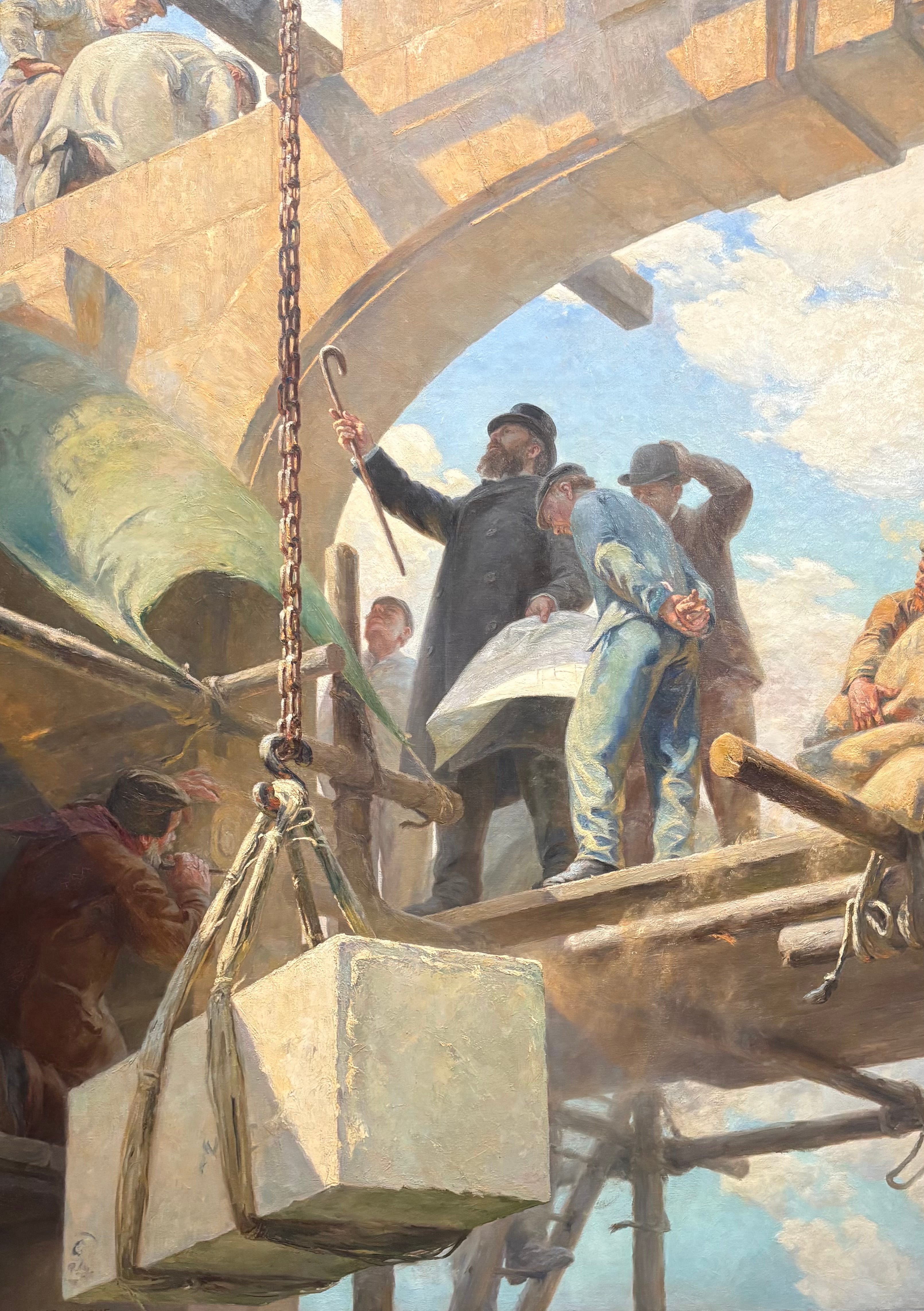
Henri Marcel Magne, L'Architecte, 1910 Musée d'Orsay
The architect of modern Chinese economic reform and industrial policy was Deng Xiaoping. After being purged twice during the Cultural Revolution, Deng not only ascended to power in his seventies, but his mental fortitude during his years of rural exile was striking. Many senior party members who had their power stripped fell into depression and never played a role in Chinese history again. Leaving his hometown of Sichuan at sixteen, Deng studied abroad in France, coincidentally alongside Zhou Enlai—a giant in modern Chinese history remembered not only for being the first premier, but also for shielding people in his Zhongnanhai home during the Cultural Revolution. Deng learned the machinery of propaganda, military, and later economic statecraft. He started China’s science and technology development, piecing back together an emaciated nation whose people had been cut off from their own history, economic resources, and any semblance of rational national development policy.
When reading Ezra Vogel’s biography of Deng, I recall asking my mom, “Why do Chinese leaders keep inflicting suffering on its lao bai xing [own people]?” Deng, having lived through the highs and lows of the early PRC, witnessed Mao’s ability to centralize power alongside the devastation of the Chinese people and economy. One policy experiment Deng oversaw in Guangdong was led by Xi Zhongxun, former secretary general and—yes—the father of China’s leader today. During Deng’s reign, Xi was provincial secretary of Guangdong and heard constituents plead to migrate to Hong Kong, where economic opportunity, wages, and quality of life were incomparably higher. Instead of assigning more police to arrest the would-be migrants, Xi pushed through policy for Guangdong Special Economic Zones in Shenzhen, Zhuhai, and Shantou to stimulate the provincial economy so citizens would want to stay in China.
It’s funny how the world comes full circle. In Patrick McGee’s Apple in China, widely read among tech circles, McGee details how Apple and the consumer electronics industry’s rise is irreversibly tied to Shenzhen’s contract manufacturing and supply chain ecosystem. This isn’t easy business. Terry Gou started Foxconn with higher margins at the start of its partnership with Apple, and today profit margins are around 2.30%. Luxshare—a competing contract manufacturer—would take the business in a heartbeat for lower margins. Luxshare was founded by Wang Laichun, a woman who was once a line worker at Foxconn and built her company to be worth $58B today, a bit more than half of Foxconn’s $105B valuation. Thanks to Xi’s father, Steve Jobs could outsource production to a Chinese SEZ and so he wasn’t responsible for debugging production lines, CNCs, and stamping. Although, the outsourcing still arrived with heavy investment from Apple, reaching $55B per year starting in 2015 in R&D dollars poured into Chinese factories. Jobs and Cook sent both Apple engineers and funding to China, creating proprietary manufacturing processes that allowed Gou and Wang to deliver on increasingly complex products. Unfortunately, as with most relationships, Apple is realizing its union with China must evolve, because manufacturing is now a national security concern.
After moving to SF, I chuckle internally every time I hear a founder say AI (“AGI, ASI, superintelligence”) will solve all problems, including manufacturing. Elon is well known for saying it’s easy to design a car and extremely difficult to produce cars at scale. It’s no surprise that the “U.S. design + China (or Asia) manufacturing” model must change. However, many open questions linger as to how AI agents and VLAs will reindustrialize the Rust Belt. The beauty of SF is that the city is filled with dreamers and optimists who believe they can build anything—the delusion is helpful—but the insular culture means many ideas don’t work in practice the same way they do in your terminal with Claude Code. I’ve met many SF founders white-boarding AI manufacturing agents (not an approach I’d take) who are getting funded under the banner of national resilience. Between Mr. Zhang, a factory CEO who has run a motor factory for twenty years and is cautiously pivoting into robotics, and a software founder in SF building agents, it’s not hard to see who is manufacturing output. Tell me, how will agents produce embodied AI? Our obsession with scalability, and the last few decades of B2B SaaS returns, make it historically difficult to justify investing in startups building anything physical. But atoms may be the real moat that remains.
Power is shifting from east to west in America, but for the rest of the world, it is too early to tell which direction AI will shift power.
Thank you to Roger Zhang for draft reviews and Ashwin Ramaswami for encouragement to post.
as AI keeps scaling, how do we avoid framing this as “software vs manufacturing,” when the real advantage seems to come from teams that understand both deeply and respect the complexity of each?